A few years ago, almost every employee had their own desk. A framed family photo, a favourite mug, a notebook, a charger or a sweater in case it got cold. Everything had its fixed place.
With the rise of hybrid work and flexible offices, this model has started to change. Many companies are moving towards shared workspaces, and employees choose a work zone depending on what they need at the moment. During the day they may look for quiet focus time, later a space for collaboration with their team, or a place to meet a client.
But greater flexibility also brings a practical question: where do you store personal belongings when you no longer have a permanent desk? And this is exactly where lockers come into play.
Lockers are not just storage
Lockers are often seen as a technical piece of office equipment. In reality, they serve a much more important role. They provide employees with something that can be surprisingly important in a flexible environment: a sense of personal space. Even if someone does not have their own desk, they still have their own place. A place to store personal items, work tools, slippers or a laptop. A place that is theirs.
But are lockers essential in offices with desk sharing?
Desk sharing without sufficient storage space usually does not work in the long term. If employees do not have a place to store their belongings, they gradually start to claim workstations. Personal items, documents and papers begin to appear on desks, and the flexibility of the space quickly disappears.
Lockers, on the other hand, support:
-
more efficient use of the office
-
easier desk sharing
-
better organisation
That is why they are now a standard feature in modern flexible offices. In smaller offices, they can be replaced by small storage boxes where everyone can keep what they need.
So why do companies use them even in places where everyone has their own desk? This is a trend we are seeing more and more often, and the reason is simple. Companies want to create cleaner, more organised and more representative environments.
Thanks to lockers, work desks do not get cluttered with personal items, and the office feels more open and supports focused work.
Clean desk policy works better when people have somewhere to put their things
Expecting employees to leave their desk clean at the end of the day makes sense, especially in flexible offices where workstations are shared. But for a clean desk policy to work in practice, people need somewhere to store their belongings.
And it is not just about laptops or notebooks. Everyone brings a range of small personal items to the office that make their workday more comfortable: slippers, vitamins, a water bottle, sports clothes or things for an afternoon yoga class. Lockers give these items their place and help keep the office clear, organised and ready for whoever uses it.
Clean desk policy is also important not only from an organisational perspective but also in terms of office maintenance. If desks are free of personal items, documents and electronics, cleaning can be done more thoroughly and efficiently. An empty workspace is much more accessible for cleaning staff, helping the office maintain a higher standard of cleanliness and order over time.
Security as a standard, and what comes after that?
Open, lockable, ventilated or smart access via an app. There are many options on the market today, and the choice depends on the role lockers are meant to play in the office.
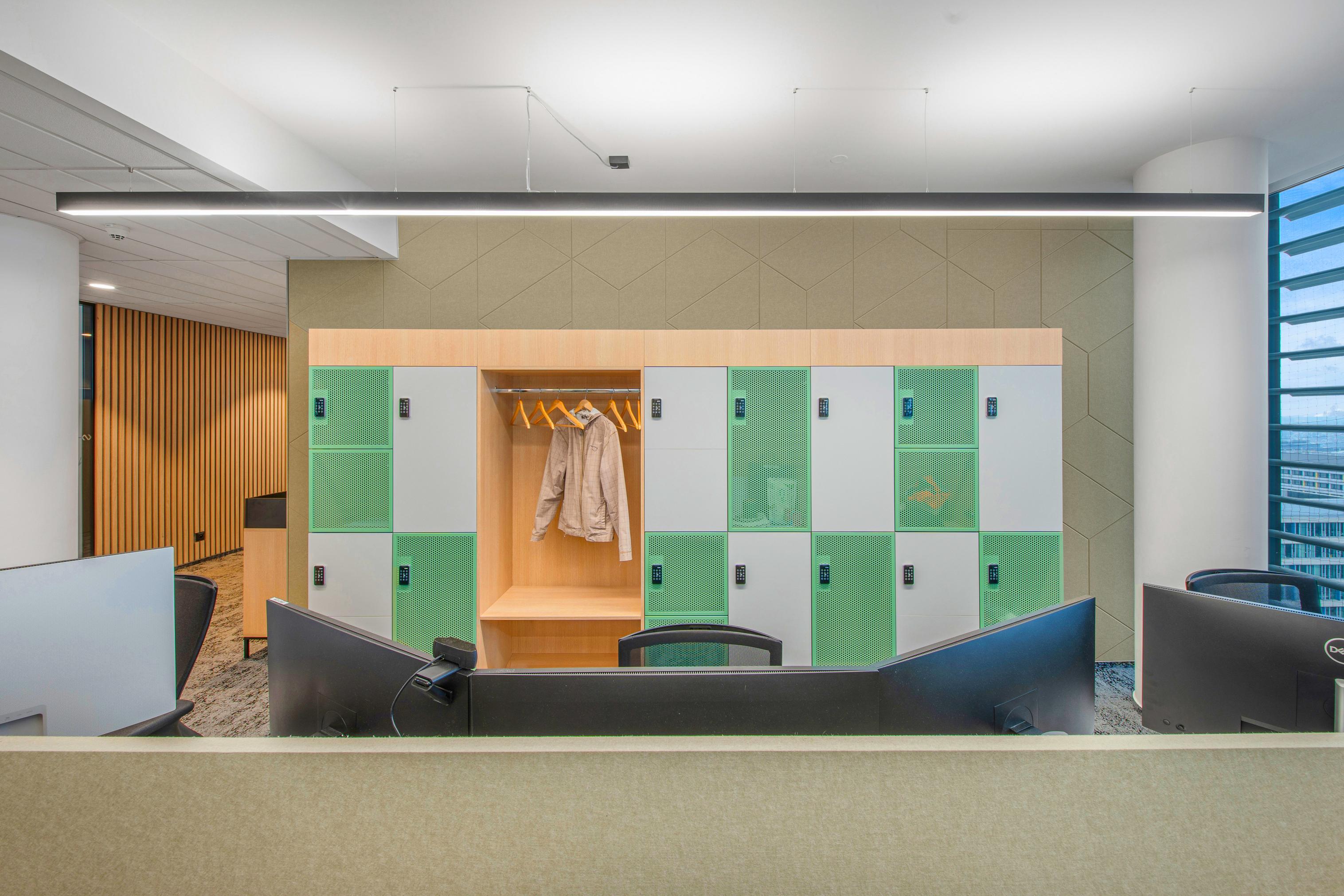
Smart lockers are becoming increasingly popular, offering access via mobile phone, code or company card. They are no longer used only for storing personal belongings. They can also serve as a secure point for exchanging documents between colleagues, collecting IT equipment or receiving courier deliveries. Once an item is placed inside, the recipient receives a notification with an access code and can pick it up at any time during the day.
The placement of lockers in an office also needs careful planning. Personal lockers should ideally be located close to team zones so they are easily accessible during the workday. Lockers intended for couriers and deliveries make the most sense near the entrance or reception, where they enable a smooth and secure handover process.
From a functional element to a design feature
At SpaceIN, we see lockers as more than just technical equipment. They are part of the office design that shapes how people work and move through the space. They can help define zones, visually calm the environment or highlight a company’s identity.
Today, companies are not only considering how many lockers they need, but also how they fit into the overall architecture of the space, from materials and colours to the way they are used. In this way, lockers are becoming a natural part of the modern workplace rather than just a practical add on.